I Have a B.Tech/BCA Degree, But I'm Still Not Employable — Here's Your 6-Month Roadmap
By CodingDidi · Aug 7, 2026 · 7 min read
<!--
SEO META (paste into your CMS fields — not part of the visible post)
Title tag: B.Tech/BCA Degree But Still Not Employable? Here's Your 6-Month Roadmap (2026)
Meta description: Confused after B.Tech or BCA? Take the free self-assessment, follow the career decision flowchart, and get a 6-month roadmap to become job-ready — coding or non-coding.
Target keyword: b.tech bca not employable career roadmap
Secondary keywords: how to become job ready after btech, coding vs non-coding career, career roadmap for engineering graduates 2026
URL slug: /blog/btech-bca-not-employable-career-roadmap
-->
You did everything you were told to do.
Four years of engineering or BCA. Assignments submitted on time. A CGPA you're not ashamed of. And yet — six months post-graduation, or worse, six months before graduation with placement season closing in — you're staring at job portals feeling like a fraud. Not because you're lazy. Because nobody ever taught you what "job-ready" actually means.
You're not alone, and you're not broken. You're a symptom of a curriculum-vs-market gap that's affecting your entire batch. The good news: the gap is closable in months, not years — but only if you stop guessing and start following a structured path.
This post breaks down why the gap exists, and gives you a free, self-assessment-driven roadmap to close it.
Why So Many B.Tech and BCA Graduates Stay Unemployed
Here's the uncomfortable truth: a degree certifies that you sat through a curriculum. It does not certify that you can produce value — solve an ambiguous problem, ship working code, or explain your thinking to a stranger in an interview.
The data backs this up. According to the India Skills Report 2026 — jointly compiled by Wheebox, CII, and AICTE from responses across 100,000+ candidates — overall graduate employability sits at roughly 56%, and even engineering graduates, historically the strongest cohort, saw employability dip slightly to just over 70% as hiring bars keep rising (full report coverage on Careers360). Translation: more than 4 in 10 graduates — across every stream — are not considered hire-ready the day they walk out with a degree.
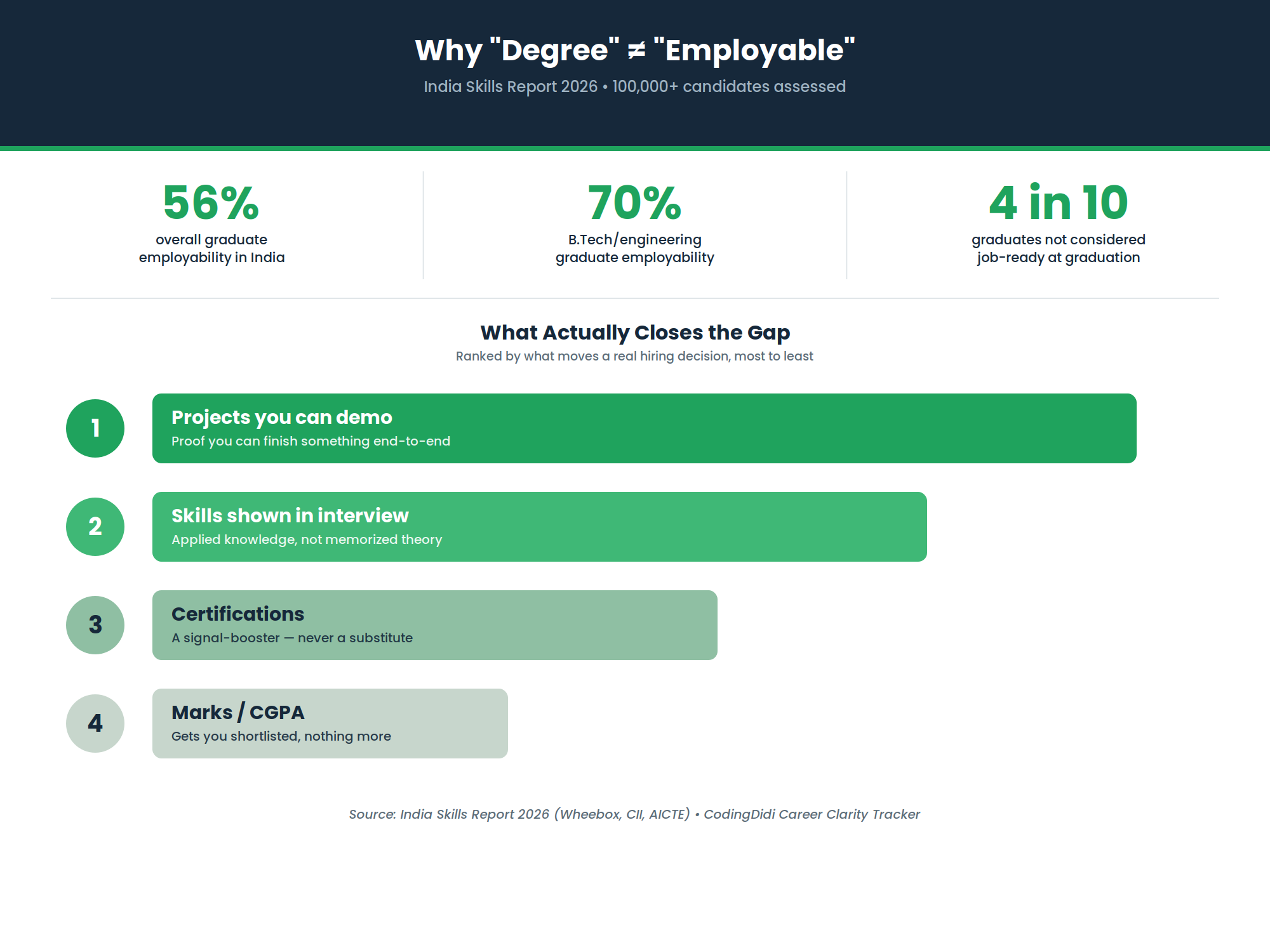
It's rarely about intelligence. It's almost always one of these:
- Chasing marks instead of building anything real. A transcript doesn't demo well in an interview.
- Learning syntax, never finishing a project end-to-end. Tutorials feel like progress; they aren't proof.
- Avoiding DSA and system thinking until placement panic hits, instead of building the habit early.
- Never touching Git, deployment, or a real team codebase — so the first job's actual workflow feels foreign.
- Staying inside the syllabus instead of following curiosity into the tools companies actually use.
None of these are character flaws. They're default outcomes of a system optimized for exams, not employability. Fixing them just requires a different system — one built around evidence (projects, skills you can demonstrate) rather than paper (marks, certificates).
The Real Question Isn't "Am I Employable?" — It's "Which Lane Am I Even In?"
Most career advice skips a step. It tells you to "learn Python" or "get into Product Management" without first checking whether that path fits you. That's how people burn eight months learning React only to realize they hate front-end work — or grind DSA for a coding role when they'd actually thrive in something like business analysis or UX.
Before you pick a roadmap, you need an honest read on:
- How much you genuinely enjoy logical problem-solving vs. people-facing communication
- Your comfort with math and structured thinking
- Whether you're drawn to building things or analyzing and translating between groups
- Your creative instincts, risk tolerance, and preferred way of learning
Answer these honestly, run them through a decision flowchart, and you get a starting lane — coding (Python/Full-Stack, Data Analyst, ML Engineer, Data Engineer, Cloud/DevOps) or non-coding (Business Analyst, Product Manager, UI/UX Designer, Digital Marketing, Cybersecurity GRC, Technical Recruiting) — instead of guessing based on what your friends are learning.
This is exactly the gap the CodingDidi Career Clarity Tracker was built to close.
What the Career Clarity Tracker Actually Gives You
This isn't a generic "top 10 skills to learn in 2026" listicle. It's a structured, self-assessment-driven system:
- A scored self-evaluation across 13 categories — logical reasoning, math comfort, creativity, communication, business understanding, and more — that tells you where you actually stand, not where you assume you stand.
- A visual career decision flowchart mapping your answers to 12 real career outcomes, so you leave with a specific lane, not a vague direction.
- Deep-dive playbooks for all 12 roles — salary ranges (India + global), tech stacks, project ideas, portfolio guidance, and interview prep, for both coding and non-coding paths.
- Month-by-month 6-month roadmaps you can actually follow, with weekly goals instead of an overwhelming syllabus dump.
- An AI-tools playbook — how to use ChatGPT, Claude, GitHub Copilot, and Cursor to learn faster and build faster, since AI fluency is now a hiring signal in its own right. The World Economic Forum projects that AI will displace around 92 million roles globally by 2030 while creating roughly 170 million new ones — a net gain, but only for people who adapt their skill set alongside the shift (WEF: The AI-driven workforce is here).
- Downloadable templates — resume structure, portfolio checklist, project tracker, and a 100-project-ideas list — so execution isn't the bottleneck.
Download the free Career Clarity Tracker →
How to Use the Tracker in the Next 7 Days
You don't need six months of "figuring it out" before you start. You need seven days of focused action:
- Day 1–2: Complete the self-assessment honestly. Don't answer as who you want to be — answer as who you are today.
- Day 3: Run your scores through the decision flowchart and identify your primary lane.
- Day 4–5: Read the full playbook for that role — salary expectations, tech stack, and the specific projects that actually move a hiring decision.
- Day 6: Block out your Month 1 roadmap in a calendar. Vague intentions don't survive contact with placement season; scheduled blocks do.
- Day 7: Start Month 1, Week 1 — today, not "from Monday."
FAQs
I have zero coding experience. Can I still land a tech-adjacent job?
Yes — several of the strongest non-coding paths (Business Analyst, Product Manager, Technical Recruiter) live inside tech companies without requiring you to write production code. The tracker's flowchart routes you there if that fits your profile better.
Is DSA mandatory for every path?
No. It matters for coding roles at most companies, but non-coding tech careers weigh different skills — communication, structured analysis, tool fluency — more heavily.
Can I switch lanes later if I pick wrong?
Absolutely. The flowchart is a compass, not a life sentence. Many people shift once they've actually started building and discover what they enjoy in practice.
Is six months realistic while I'm still studying or working?
The roadmap assumes roughly 4–5 focused hours a day. If you're balancing college or a job, stretch it to 8–9 months — the sequence matters more than the exact timeline.
Stop Guessing. Get a Plan.
A degree gets you in the door of the conversation. It was never going to be the whole job search. What closes the gap is evidence — projects, demonstrated skills, and a plan you actually followed instead of one you kept meaning to start.
The self-assessment takes fifteen minutes. The clarity it gives you is worth a lot more than another semester of hoping the market sorts itself out.
Take the self-assessment and download your Career Clarity Tracker →
Further reading: India Skills Report 2026 findings · World Economic Forum on AI and the future of jobs