Google's New Hiring Process: What Changed in 2026
By CodingDidi · Nov 11, 2026 · 6 min read
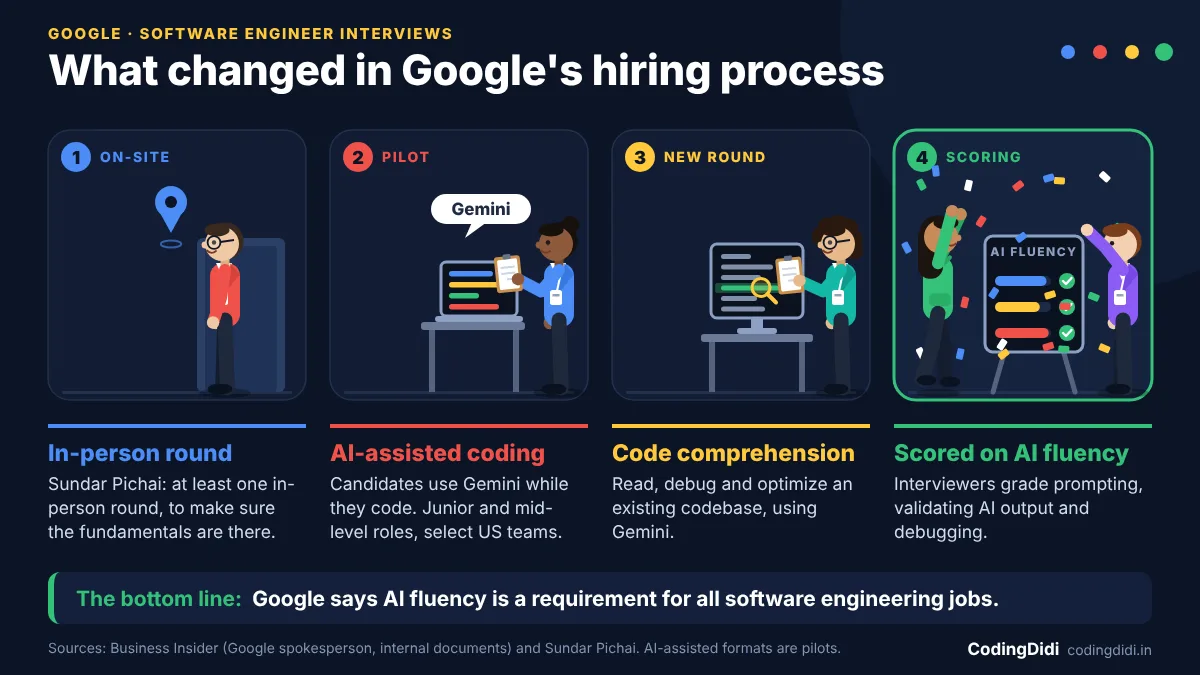
The Google hiring process is being updated for the AI era. Based on reporting from May 2026, Google is piloting a coding interview where candidates may use its Gemini assistant, and interviewers score "AI fluency": prompting, checking the AI's output and debugging. The behavioral "Googleyness and Leadership" round is reported to add a technical design discussion about your past work. Google also said in 2025 that it would bring back at least one in-person round. The basic structure (recruiter screen, technical interviews, hiring committee, team match) still looks the same. Most of the new format is a pilot for software engineers in select U.S. teams, so confirm your own format with your recruiter.
Few employers get more attention from job seekers than Google, and few interview processes get more second-hand advice. A lot of that advice is out of date. This guide separates what has been reported by credible outlets from what is guesswork, then gives you a practical way to prepare.
One note before we start: Google has not published a full public description of these changes. Most of what follows comes from news reports on an internal document, plus comments from a Google spokesperson and its VP of recruiting. I label each point so you know how solid it is.
What Is Actually New in the Google Hiring Process?
1. An AI-assisted coding interview (pilot)
In May 2026, Entrepreneur reported that Google is piloting an interview where candidates can use an AI assistant. The report cites an internal Google document seen by Business Insider.
Here is what that report says:
- The round is a "code comprehension" interview. Instead of writing an algorithm from a blank screen, candidates review an existing codebase, find bugs and improve performance.
- A Google spokesperson said the assistant used in the pilot is Gemini.
- Interviewers will assess "AI fluency," including prompt engineering, output validation and debugging.
- It starts with select U.S.-based teams hiring early- and mid-career software engineers. Google may expand it to more groups and regions if it works.
- Brian Ong, Google's VP of recruiting, told Business Insider the pilot is meant to be "more reflective of how our teams are operating in the AI era."
A later write-up from Let's Data Science, which cites Business Insider, says the changes rolled out in phases during 2026 and have reached more parts of the company. The same piece says it is still unclear which levels and organizations use the format and how AI-assisted work is scored. Google still calls it a pilot.
2. A technical discussion added to the "Googleyness and Leadership" round
The same May report says the Googleyness and Leadership round, which has mostly covered behavioral questions, will add a technical design discussion based on your past work. In practice, that means you should be ready to explain a real project you built: the decisions you made, the trade-offs, and what you would change.
3. A different technical round for early-career candidates
For early-career candidates, the report says one traditional technical interview will be replaced with a session on open-ended engineering problems. The report does not say how that session is scored, so treat the details as unknown.
4. In-person interviews are coming back
In 2025, Entrepreneur reported that Sundar Pichai said on a podcast that Google is reintroducing "at least one round of in-person interviews," with the stated aim of making sure candidates have mastered "the fundamentals." The article links this to AI cheating in virtual interviews, but that framing is the publication's, not a direct Pichai quote.
A third-party guide from TechScreen adds that hybrid loops are now common, remote rounds often include camera and screen checks, and Google hasn't published a detailed policy for every role. Ask your recruiter exactly which rounds are onsite and which are virtual.
What Has Not Changed: The Core Stages
Based on the same TechScreen guide (a third-party source, not Google), a typical software engineering process still looks like this:
- Recruiter screen (about 20 to 30 minutes). Background, target level, location and timeline.
- Online assessment for new grads and interns, and usually skipped by experienced hires.
- Technical phone screen (about 45 minutes) with live coding in a shared editor.
- Onsite loop of four to five interviews of about 45 minutes. Senior levels swap some coding rounds for system design.
- Hiring committee. Senior engineers who did not interview you review the written feedback and decide on hire and level.
- Team match. Hiring managers with open headcount speak with approved candidates. This is the most variable step.
- Offer.
The guide estimates 6 to 10 weeks from first contact to offer. Treat that as a rough guide, because timelines vary a lot by team and season.
What "AI Fluency" Probably Means (and What We Don't Know)
Google has not published a scoring rubric, so be careful with any article that claims to know exactly how you'll be graded. The reported criteria, "prompt engineering, output validation, and debugging," give us three honest clues:
- Prompting: can you describe a problem clearly enough for an assistant to help?
- Validation: do you check what the assistant gives you instead of trusting it? This looks like the heart of the format.
- Debugging: when the generated code is wrong, can you find out why and fix it?
My interpretation is that the format rewards the person who stays in charge of the work. An assistant that writes code you can't explain is a liability in this kind of interview. That is my reading, not a published Google criterion.
How to Prepare for the New Google Interview
This plan is my suggestion based on the reported format. Adjust it once your recruiter tells you what your loop includes.
Week 1–2: Rebuild your fundamentals
Because Google has said it wants to verify fundamentals, do not let AI tools replace basic practice. Solve data structure and algorithm problems without autocomplete or an assistant, and explain your approach out loud as you go.
Week 3: Practice reading and fixing code
Code comprehension is a different skill from writing code from scratch. Pick open-source projects or your own old code and practice:
- Reading an unfamiliar file and summarizing what it does.
- Finding a bug from a failing test or a vague bug report.
- Making a slow function faster and explaining how you know it's faster.
Week 4: Practice working with an AI assistant on purpose
Use any assistant on a practice task and add a rule: you must check every answer before you accept it. Write a test, run it, and note where the assistant was wrong. That habit of validating output is exactly what the reported criteria describe.
Throughout: Prepare two project stories
For the design discussion, choose two projects you've really built. For each, be ready to cover the problem, the design options you considered, why you chose one, what went wrong and what you'd do differently. Only use work you can discuss in depth, because follow-up questions will find the gaps.
Common Mistakes Candidates Make
Relying on old advice. Many popular guides describe a process from before 2025. Check the publication date and compare against recent reports.
Assuming everyone gets the AI round. The pilot targets select U.S. teams and specific levels. Your loop may look quite different, so ask.
Letting the assistant do the thinking. If you paste a prompt and accept the output, you give the interviewer nothing to evaluate. Narrate your reasoning.
Skipping behavioral preparation. The Googleyness and Leadership round still matters, and it is reportedly gaining a technical element.
Believing "guaranteed" claims. No one outside Google knows exactly how decisions are made. Be skeptical of anyone selling certainty.
Frequently Asked Questions
Q-1 What is the Google hiring process?
The Google hiring process typically includes a recruiter screen, one or more technical phone screens, an onsite or virtual interview loop, a hiring committee review, team matching and an offer. Exact steps vary by role and level.
Q-2 Does Google allow AI in interviews now?
Google is piloting an AI-assisted coding interview for some software engineering candidates, where a Google spokesperson said candidates use Gemini. It is limited to select U.S. teams and early- and mid-career roles, and Google may expand it.
Q-3 Is Google bringing back in-person interviews?
Yes, according to reports. In 2025, Sundar Pichai said Google is reintroducing at least one in-person interview round, with the stated goal of confirming candidates know the fundamentals. Ask your recruiter which rounds are in person.
Q-4 What is "AI fluency" in a Google interview?
According to a report on an internal Google document, AI fluency includes prompt engineering, validating AI output and debugging. Google has not published a detailed scoring rubric.
Q-5 How long does the Google hiring process take?
Third-party guides estimate about 6 to 10 weeks from first contact to offer, with team matching being the most variable step. Timelines differ by team, level and hiring season.
Next Steps
Ask your recruiter three questions at the start: which rounds are in person, whether your loop includes an AI-assisted round, and which level you're being considered for. Then build your plan around the answers.
To build the fundamentals the interviews test, start with our Python roadmap and free trackers, and practice queries with our guide to free websites to practice SQL online.