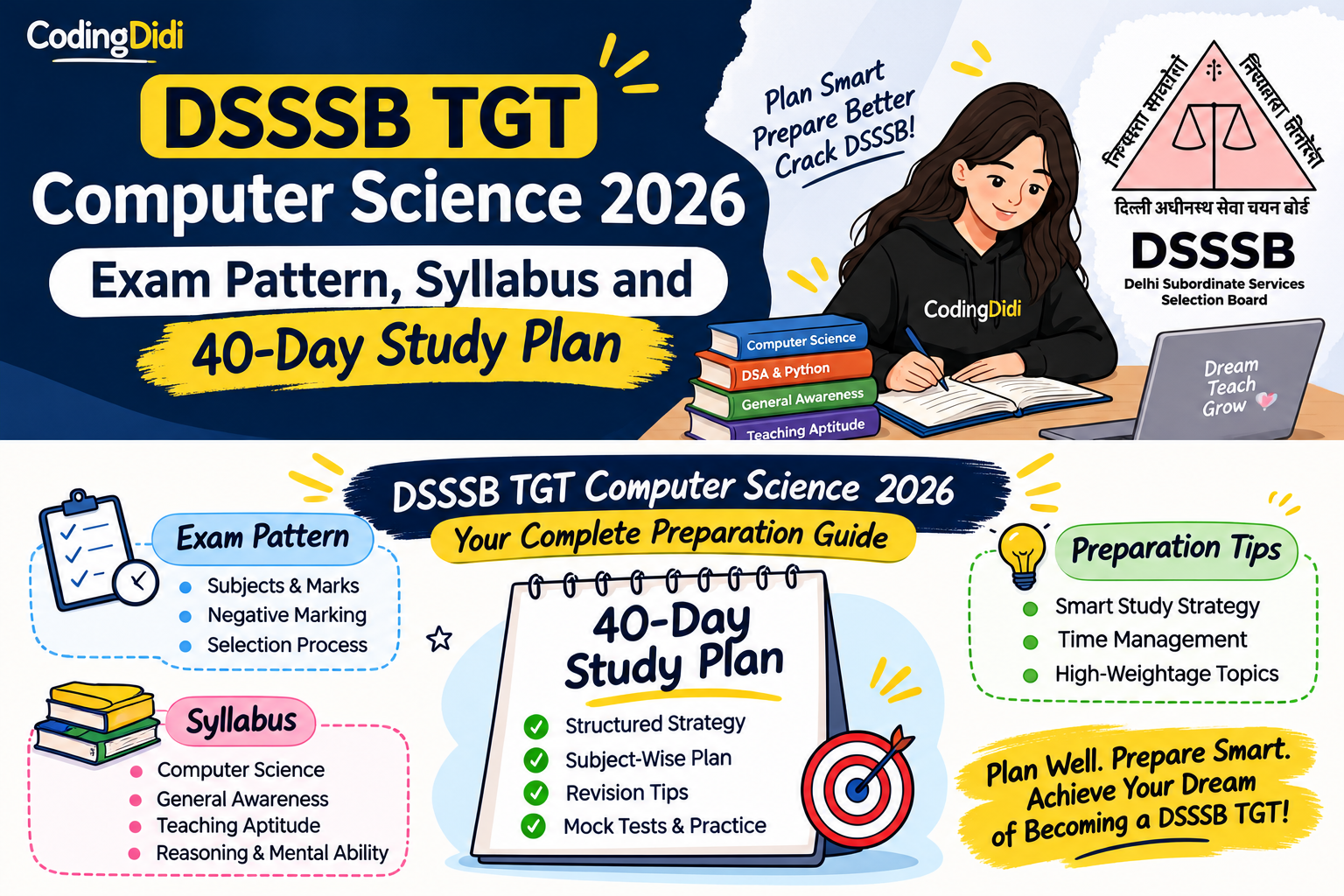
DSSSB TGT Computer Science 2026: Exam Pattern, Syllabus and 40-Day Study Plan
By CodingDidi · Oct 16, 2026 · 8 min read
Who this guide is for
If you have applied for the Delhi government's TGT Computer Science post and have not started preparing, 40 focused days are enough to cover the whole paper once, revise it and sit three full mocks. The computer-based test is scheduled from 27 November to 4 December 2026, so a start in mid-October leaves a day or two of slack.
This guide explains how the paper is built, what each section tests and how to spread five general subjects and 32 computer science topics over forty days. At the end you can download a free Excel tracker that turns the plan into a daily checklist.
It assumes you already hold a computer-related degree (BCA, B.Tech or similar), which is what the post requires, and that you can study about six hours a day.
The exam at a glance
The paper is a single 200-mark computer-based test, split evenly between general subjects and computer science.
| Feature |
Detail |
| Post |
TGT (Computer Science), Post Code 41/26, Advt No. 03/2026 |
| Recruiting body |
DSSSB, for the Directorate of Education, Delhi |
| Reported vacancies |
675 (most sources; one site gives a higher figure, so check the notice) |
| Exam days |
27, 28 and 30 Nov; 1, 2, 3 and 4 Dec 2026, in up to three shifts a day |
| Mode |
Computer-based test, objective multiple-choice |
| Questions and marks |
200 questions, 1 mark each (100 in Section A, 100 in Section B) |
| Time allowed |
120 minutes for the whole paper |
| Wrong answers |
0.25 marks deducted each |
| Pay |
Level 7, Rs 44,900 to 1,42,400 |
The minimum qualifying score is 40% (80 marks) for General and EWS candidates, 35% (70) for OBC (Delhi) and 30% (60) for SC, ST and PwBD. These are floors, not cut-offs: the merit list is built from the combined Section A and Section B score, and there is no interview.
Section A: five subjects, 20 marks each
Section A is half of the paper and is shared by every DSSSB TGT subject. Two of its subjects reward daily practice more than reading.
| Subject |
Marks |
What is tested |
How to approach it |
| General Awareness |
20 |
History, polity, economy, geography, science, sports, current affairs including Delhi |
Read the last six months of current affairs, then revise static topics in short passes |
| Reasoning |
20 |
Analogies, series, coding-decoding, blood relations, directions, puzzles, syllogisms, figures |
Timed daily sets; learn each question type once, then drill |
| Arithmetic |
20 |
Number system, simplification, ratio, percentage, averages, profit and loss, interest, time and work |
Memorise formulas once, then build speed with practice |
| Hindi |
20 |
Grammar, vocabulary, synonyms and antonyms, sentence structure, comprehension |
Revise grammar rules, then solve unseen passages |
| English |
20 |
Error spotting, fill in the blanks, idioms, active-passive, narration, comprehension |
Grammar first, vocabulary daily, passages for speed |
Section B: the 32-topic computer science syllabus
Section B carries 100 marks and follows the Directorate of Education's list of 32 topics. It is wider than a typical degree paper because it mixes programming and systems with electronics, mathematics and a few management subjects. Grouping the topics into eight clusters makes them easier to plan around; the numbers in brackets are the official topic numbers.
| Cluster |
Topics |
| Programming (5) |
C, data structures and C++ (4); object-oriented programming and numerical techniques (12); Java and website design (14); .NET programming (18); problem solving and programming (29) |
| Systems and fundamentals (5) |
Computer basics and PC software (3); fundamentals of IT (5); computer architecture (9); operating systems (15); Linux (19) |
| Data, algorithms and software (4) |
DBMS (8); front-end design tools (10); software engineering (13); design and analysis of algorithms (21) |
| Networks and security (4) |
Computer networks (17); network security (22); mobile computing (24); TCP and protocols (31) |
| Web and multimedia (3) |
E-commerce (20); computer graphics and multimedia (25); internet programming (26) |
| Electronics and physics (2) |
Basis of physics (6); digital electronics (7) |
| Maths and statistics (3) |
Mathematics I to IV (1); statistical techniques (30); interpolation (32) |
| Management and English (6) |
Business communication and management (2); financial accounting (11); business economics (16); MIS (23); knowledge management (27); foundation English (28) |
Topics other sites add. Some prep sites also list Python, file handling, cyber ethics and teaching methodology. File handling and cyber topics already sit inside the C, C++ and IT fundamentals topics. Python and pedagogy do not appear in the 32-topic list, so treat them as an hour of insurance each, and check the official syllabus PDF before the exam.
The 40-day plan in four phases
The plan spends thirty days learning, four days revising, five days on mocks and one day resting.
| Phase |
Days |
Focus |
| 1. Learn |
1 to 30 |
Every Section B topic and every Section A subject, side by side, with a 50-question checkpoint on days 7, 14, 21 and 28 |
| 2. Consolidate |
31 to 34 |
One revision cluster per day plus timed Section A drills |
| 3. Mock and fix |
35 to 39 |
Full mocks on days 35, 37 and 39, with a weak-area fix day after the first two |
| 4. Final |
40 |
Light revision, admit card and travel check, early sleep |
Here is the order in which Section B is covered during the learning phase.
| Days |
Section B topics |
Official topic numbers |
| 1 to 7 |
Computer basics, IT fundamentals, problem solving, C, data structures, C++, numerical techniques |
3, 5, 29, 4, 12, 32 |
| 8 to 11 |
Algorithms, Java, .NET, front-end tools |
21, 14, 18, 10 |
| 12 to 19 |
DBMS, operating systems, Linux, architecture, digital electronics, physics, mobile computing |
8, 15, 19, 9, 7, 6, 24 |
| 20 to 25 |
Networks, protocols, security, e-commerce, internet programming, graphics, software engineering |
17, 31, 22, 20, 26, 25, 13 |
| 26 to 30 |
MIS, knowledge management, business communication, accounting, economics, English, maths, statistics |
23, 27, 2, 11, 16, 28, 1, 30 |
The heavier topics (C and data structures, algorithms, DBMS, operating systems, networks) get two days each. Light topics such as physics, accounting and economics are paired up. If you start later than mid-October, merge those light topics first rather than dropping mocks.
A daily routine that fits in six hours
Each study day has three blocks:
- Section B, about 3.5 hours. Learn the day's topic, then summarise it in five lines of your own.
- Section A, about 1.5 hours. One subject per day.
- Practice, about 1 hour. Topic-wise questions, with every mistake written into an error log.
Start each day with a 20-minute recap of the previous day's notes.
Section A rotates through its five subjects during the first thirty days. General Awareness gets seven days because current affairs need repeated exposure; Reasoning, Arithmetic, Hindi and English get six each. Treat Arithmetic and Reasoning as skills to be drilled, not chapters to be read.
Mocks, the error log and when to guess
Take full 200-question mocks on days 35, 37 and 39, timed at 120 minutes. A mock only helps if you study it afterwards:
- Write every wrong or guessed question into an error log.
- Note the real cause: concept gap, forgotten fact, silly slip, misread question, time pressure or pure guess.
- Re-solve each one without looking at the answer.
- Use the next day to repair your three weakest topics.
With a quarter-mark penalty and four options, guessing pays once you can rule something out. These are average gains per question, assuming four options per question (confirm this on your practice paper).
| Situation |
Average gain per question |
| Blind guess among four |
+0.06 |
| One option eliminated |
+0.17 |
| Two options eliminated |
+0.38 |
Skip a question only when you have no idea at all.
Download the free 40-day tracker
Everything above is built into one Excel workbook, so you can tick off each day instead of rebuilding the plan yourself.
Download the DSSSB TGT Computer Science 40-day tracker (Excel): [https://www.codingdidi.in/trackers]
The workbook has five tabs:
- Start Here: set your start and exam dates; a live dashboard shows days done, days behind, hours logged and mock scores against your target.
- 40-Day Plan: day-by-day topics, sub-topics, syllabus references, practice tasks, a status dropdown and a confidence rating.
- Syllabus Map: all 32 Section B topics and five Section A subjects with their sub-topics, priority and progress.
- Mock Log: enter correct and wrong counts and get the net score after negative marking.
- Error Log: record each mistake, its cause and whether you have re-solved it.
To use it, open the file, type your Day 1 date on the first tab, and mark each day Done as you finish it. Every date in the plan updates from that one cell. Sub-topics marked as suggested are a standard curriculum breakdown, and the priority labels are study suggestions rather than official weightage.
Frequently asked questions
Is 40 days enough for a beginner? It is workable if you already have a computer science background and can give about six hours daily. It is tight if your programming is rusty, so spend the first minutes of each day tracing code by hand.
Which section should I start with? Both, every day. Section A is half the marks, so the plan pairs a Section B topic with a Section A subject from Day 1.
Is there an interview? No. Selection is based on the computer-based test score, followed by document verification.
Are Python and teaching methodology in the syllabus? Neither appears in the 32-topic list. Give each about an hour, and follow your official notification if it says otherwise.
What if I start after mid-October? Keep the mocks and the last revision days, and merge the lighter topics (physics, accounting, economics, knowledge management) into shared days.
Sources and how to verify
Details were checked on 16 October 2026 against these pages. Always confirm dates, pattern and syllabus on the official site and your admit card before you rely on them.
The day-wise plan, groupings and priorities are original study suggestions, not official weightage.