Data Analyst vs Data Scientist vs ML Engineer (2026)
By CodingDidi · Nov 17, 2026 · 7 min read
TL;DR: A data analyst explains what happened and why, using SQL, spreadsheets and dashboards. A data scientist predicts what will happen, using Python, statistics and machine learning. A machine learning (ML) engineer takes models and makes them run reliably inside real products. If you like communicating with business teams, start with analytics. If you like statistics and experiments, aim for data science. If you like building software systems, aim for ML engineering. All three share the same first steps (SQL and Python), so you don't have to decide on day one.
The hardest part of choosing a data career is that job titles don't mean the same thing everywhere. One company's "data scientist" builds dashboards all day. Another's "analyst" trains models. A TDWI overview of these roles makes the same point, noting that employers often blur the titles and that at smaller companies one person may do all of the work.
So instead of memorizing definitions, this guide compares what each role does, what it needs, and what the public data says about pay and demand. Then it gives you a way to decide.
What Does Each Role Actually Do?
Data Analyst: Explains What Happened
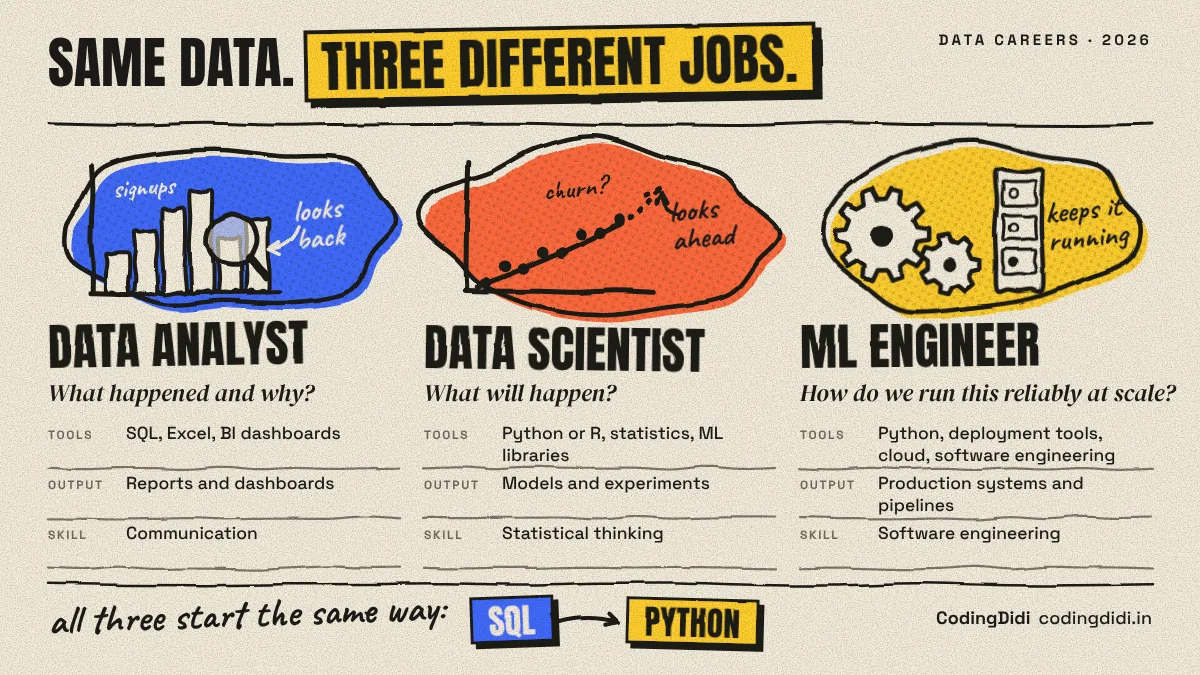
Per TDWI's comparison, the analyst makes sense of data that has already been collected, with work "oriented toward understanding the past and present." The tools are SQL, spreadsheets and business intelligence software, and the article puts strong emphasis on communicating findings. Typical outputs are queries, reports, dashboards and answers to business questions.
A typical question might be: "Why did signups drop last month, and which channel was responsible?"
Data Scientist: Predicts What Will Happen
TDWI describes the scientist as moving "from explaining what happened to predicting what will happen," for example forecasting which customers are likely to churn. The tools are Python, statistics and machine learning, with more emphasis on mathematical depth. The output is usually a predictive model or an experiment result that helps a business act before something happens.
A typical question might be: "Which customers are most likely to cancel next quarter, and what would reduce that risk?"
ML Engineer: Makes Models Work in the Real World
The ML engineer sits closest to software engineering. A model in a notebook helps nobody until it runs on real data, at real speed, without breaking. 365 Data Science describes the role as developing algorithms and implementing machine learning systems, and a guide originally published by Exponent lists deployment tools such as Kubernetes and Docker among the tools ML engineers should know. The same guide says the data scientist role is broader and typically requires more education.
A typical question might be: "How do we serve this model to thousands of users with low delay, and how will we know when it starts getting worse?"
Side-by-Side Comparison
|
Data Analyst |
Data Scientist |
ML Engineer |
| Core question |
What happened and why? |
What will happen? |
How do we run this reliably at scale? |
| Main tools |
SQL, Excel, BI dashboards |
Python or R, statistics, ML libraries |
Python, deployment tools, cloud, software engineering |
| Typical output |
Reports and dashboards |
Models and experiments |
Production systems and pipelines |
| Strongest skill |
Communication |
Statistical thinking |
Software engineering |
| Math depth |
Basic statistics |
Moderate to deep |
Moderate, with strong coding |
| Best entry point |
Direct entry is common |
Often after analyst work or a quantitative degree |
Often after software or data science experience |
The last row reflects common patterns, not strict rules. Plenty of people enter each role directly.
What the Public Numbers Say About Pay and Demand
I'll stick to official figures here, because salary claims on blogs are often unsourced.
The U.S. Bureau of Labor Statistics (BLS) tracks data scientists as an occupation. In its Occupational Outlook Handbook:
- The median annual wage for data scientists was $112,590 in May 2024, compared with $49,500 for all occupations.
- Employment is projected to grow 34% from 2024 to 2034, much faster than the average for all occupations (about 3%).
- The BLS counted about 245,900 data scientist jobs in 2024 and projects roughly 23,400 openings each year.
- Typical entry-level education is a bachelor's degree.
For a nearby analytical role, the BLS says operations research analysts had a median wage of $91,290 and projected growth of 21% over the same period.
What these numbers don't tell you: I did not find separate BLS figures for "data analyst" or "ML engineer," because those job titles don't map neatly onto one BLS category. Treat any exact salary quoted for them as an estimate from job sites, not official data. Pay also varies widely by city, industry and experience. A newer BLS edition may also have updated these numbers, so check the handbook before you quote them.
How to Choose: Five Honest Questions
1. Do you enjoy explaining things to non-technical people? If yes, analytics rewards you directly. Analysts spend a large part of their time turning numbers into decisions.
2. Do you like statistics and uncertainty? If you enjoy asking "is this effect real?" or "how confident are we?", data science fits.
3. Do you prefer building systems over analyzing results? If you'd rather write clean, tested code and watch it run in production, look at ML engineering.
4. How much math and coding are you ready to learn? Analytics has the gentlest start. Data science needs more statistics. ML engineering needs the strongest programming base.
5. What gives you the fastest first job? For most career switchers, analytics is the most accessible starting point because it asks for fewer prerequisites. From there you can move toward data science or engineering if you want to. That is a common route, not a guarantee.
One Roadmap That Works for All Three
Because the early skills overlap, you can start before you choose:
- SQL. Every one of these roles touches databases. Practice daily with a free SQL practice site.
- Python and pandas. Learn to load, clean and summarize data. Our guide to the Python libraries data analysts should learn covers the toolkit.
- Basic statistics. Averages, distributions, confidence intervals and hypothesis testing.
- A real project. Pick a public dataset and answer a real question. This is the strongest thing you can show an employer.
Then branch:
- Analyst path: add a BI tool such as Power BI or Tableau, plus storytelling with charts.
- Data scientist path: add machine learning with scikit-learn, experiment design and feature engineering.
- ML engineer path: add software engineering habits (testing, version control), then deployment, containers and monitoring.
Common Mistakes When Choosing a Data Career
Choosing by job title alone. Read the actual job description. The same title can mean very different work at different companies.
Skipping the basics to chase machine learning. Weak SQL and data-cleaning skills hold back every role, including the glamorous ones.
Believing one role is "above" the others. They are different jobs with different strengths. A strong analyst is more valuable than a weak data scientist.
Collecting certificates instead of projects. Hiring managers want evidence you can solve a real problem.
Waiting until you feel ready. Start applying for analyst-style roles while you keep learning. Real postings teach you what employers actually want.
Frequently Asked Questions
What is the difference between a data analyst and a data scientist?
A data analyst explains past and present data using SQL, spreadsheets and dashboards. A data scientist uses Python, statistics and machine learning to predict future outcomes. Analysts focus on reporting and insight, while scientists focus on models and experiments.
Is an ML engineer the same as a data scientist?
No. A data scientist builds and tests models to answer business questions, while an ML engineer turns models into reliable software that runs in production. The two roles overlap, and at some companies one person does both.
Which is easiest to start with: data analyst, data scientist or ML engineer?
Data analyst is usually the easiest entry point because it needs fewer prerequisites, mainly SQL, spreadsheets and basic statistics. Data scientist and ML engineer roles typically ask for stronger programming, math or software engineering skills.
Do data scientists earn more than data analysts?
BLS reports a median wage of $112,590 for data scientists in May 2024, but it does not publish a separate figure for data analysts. Job-site estimates often show data scientists earning more, though pay varies by employer, city and experience.
Can I move from data analyst to data scientist?
Yes. Many people start as analysts, strengthen their Python and statistics, and move toward data science. Building machine learning projects and learning experiment design makes the transition easier.
Next Steps
Pick the path that fits your answers to the five questions, then start the shared roadmap this week: SQL first, then Python and pandas. If you want a day-by-day plan, the free trackers on CodingDidi give you a checklist to follow, and a 1:1 session can help you decide on a direction.
Read the original