30-Day DSA Roadmap for Placement Preparation
By CodingDidi · Oct 11, 2026 · 5 min read
Placement season has a way of arriving faster than anyone expects. One month you are comfortable with your syllabus, and the next you are staring at an online assessment with three coding questions and ninety minutes on the clock. If that sounds familiar, take heart: a focused month of Data Structures and Algorithms (DSA) practice can move you from anxious to interview-ready, provided you follow a plan instead of jumping between random problems.
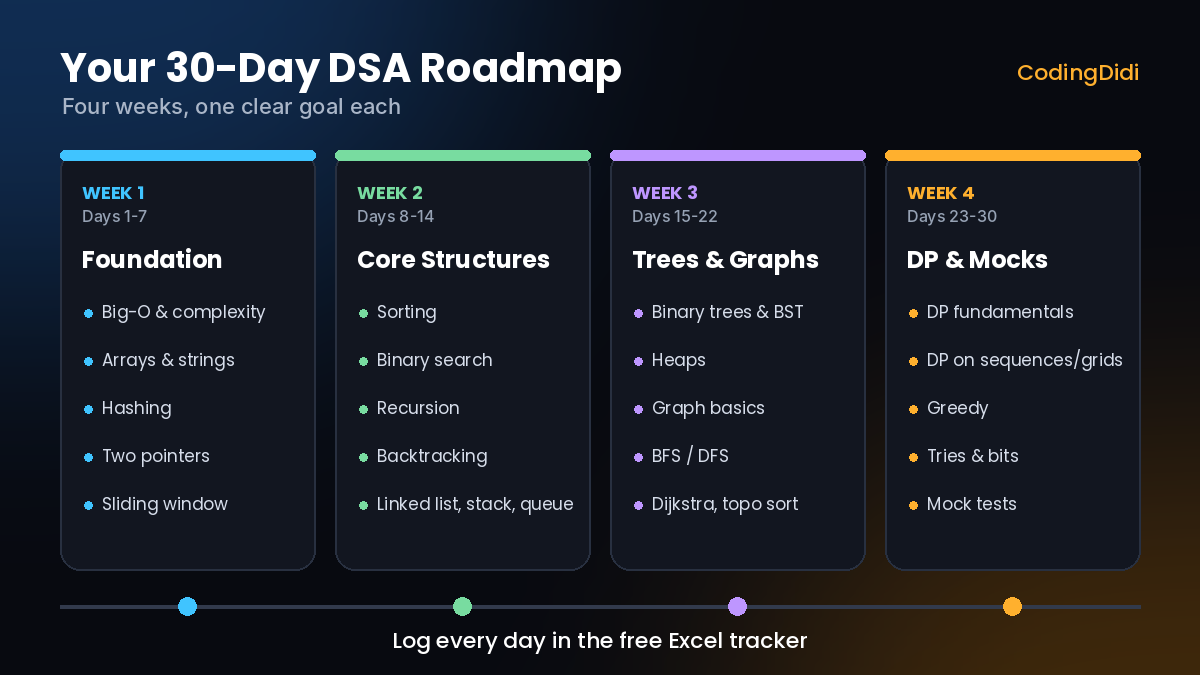
This roadmap breaks the month into four weeks, each with a clear purpose. It assumes you already know one programming language (C++, Java, or Python) and can write basic loops and functions. At the end, I explain how a simple Excel tracker will keep you honest every single day.
Why 30 Days Can Work
Thirty days will not make you a competitive programming champion, and that is fine. Most campus placements and entry-level interviews test a predictable set of ideas: arrays, strings, hashing, linked lists, stacks, queues, trees, graphs, recursion, and an introduction to dynamic programming. Companies want to see that you can recognise a pattern, pick a sensible data structure, and explain your reasoning aloud.
The secret is not volume. Solving 300 problems carelessly teaches less than solving 100 problems and truly reviewing each one. Plan for roughly three to four hours daily, split between learning a concept and applying it.
Ground Rules Before You Begin
Pick one language and stay with it. Switching mid-month wastes energy. Choose the language you will use in interviews.
Learn the pattern, not the answer. After each problem, write one line describing the trick: "needed O(1) lookup, so used a hash map" or "sorted first, then used two pointers."
Always state complexity. Interviewers ask about time and space almost every time. Make it a habit from day one.
Attempt before peeking. Spend at least 20 to 30 minutes thinking before reading any hint. Struggle is where learning happens.
Week 1: Build the Foundation
The first week is about speed with basics and getting comfortable with analysing your own code.
Before beginning start with brushing up basic in programming language like conditional statement, loops, functions and some comprehension techniques.
Day 1: Complexity and basics. Study Big-O notation, how to read time and space cost, and why a nested loop usually means O(n²). Solve five simple problems such as finding the maximum, reversing an array, and checking for a palindrome.
Day 2: Arrays I. Practise traversal, rotation, and finding the second largest element. Learn to work in place whenever possible.
Day 3: Arrays II. Move on to Kadane's algorithm for the maximum subarray, merging sorted arrays, and removing duplicates.
Day 4: Strings. Cover anagram checks, frequency counting, and reversing words in a sentence. Pay attention to how your language handles string immutability.
Day 5: Hashing. Understand hash maps and sets. Solve the classic pair-sum problem, find duplicates, and count the frequency of elements. Hashing quietly powers a huge share of interview solutions.
Day 6: Two pointers and sliding window. These two patterns solve dozens of problems that look hard at first. Try longest substring without repeating characters and the maximum sum of a window of size k.
Day 7: Revision and a timed test. Redo any problem you struggled with this week, then attempt three fresh questions under a timer. Rest of the evening: relax.
Week 2: Core Structures and Recursion
Now you move from simple containers to structures that demand more careful thinking.
Day 8: Sorting. Know bubble, selection, and insertion sort conceptually, but focus on merge sort and quick sort. Be ready to explain stability and average versus worst-case behaviour.
Day 9: Binary search. Beyond the textbook version, practise searching in a rotated array, finding the first or last occurrence, and the "binary search on the answer" idea.
Day 10: Recursion. Start with factorial and Fibonacci, then power of a number and generating subsets. Draw the call stack on paper until it feels natural.
Day 11: Backtracking. Tackle permutations, combination sum, and the N-Queens idea. Backtracking is simply recursion with an undo step.
Day 12: Linked lists. Reverse a list, detect a cycle using fast and slow pointers, find the middle node, and merge two sorted lists. Draw every pointer change.
Day 13: Stacks. Solve balanced parentheses, next greater element, and evaluate a postfix expression.
Day 14: Queues and revision. Implement a queue using stacks, then study the sliding window maximum using a deque. Finish with a mini mock test.
Week 3: Trees, Heaps, and Graphs
This is the heaviest week, and it is where many students lose momentum. Stay patient.
Day 15: Binary trees. Learn inorder, preorder, and postorder traversals both recursively and iteratively, along with level-order traversal.
Day 16: Tree problems. Compute height, check whether a tree is balanced, find the diameter, and locate the lowest common ancestor.
Day 17: Binary search trees. Practise insertion, search, validation, and finding the kth smallest element.
Day 18: Heaps and priority queues. Solve kth largest element, merge k sorted lists, and top-k frequent elements. Know when a heap beats sorting.
Day 19: Graph basics. Learn adjacency lists versus matrices, then implement breadth-first and depth-first search.
Day 20: Graph applications. Count connected components, solve the number-of-islands problem, and detect a cycle.
Day 21: Shortest paths and ordering. Study Dijkstra's algorithm and topological sort at an introductory level.
Day 22: Revision day. Solve a mixed set of tree and graph questions without looking at notes.
Week 4: Dynamic Programming, Polish, and Mocks
The final stretch blends a new topic with serious interview rehearsal.
Day 23: DP fundamentals. Understand overlapping subproblems and optimal substructure. Convert plain recursion to memoization, then to a bottom-up table, using Fibonacci and climbing stairs.
Day 24: DP on sequences. Solve house robber, coin change, and longest increasing subsequence.
Day 25: DP on grids and strings. Try unique paths, minimum path sum, and longest common subsequence.
Day 26: Greedy algorithms. Cover activity selection, jump game, and interval merging. Learn to judge when a greedy choice is actually safe.
Day 27: Tries and bit manipulation. Get a light introduction. Implement a basic trie and learn tricks such as checking odd or even, and counting set bits.
Day 28: Company-style mock test. Simulate a real online assessment with three questions in ninety minutes. Review every mistake afterward.
Day 29: Weak-spot day. Look at your tracker, identify your three weakest topics, and spend the day only on those.
Day 30: Final mock and mindset. Take one more timed test, then rehearse explaining two or three solutions aloud as though an interviewer were listening.
A Daily Routine That Works
Link to Tracker: https://www.codingdidi.in/trackers
A simple rhythm keeps the month manageable:
- Morning (60–90 minutes): Study the day's concept and write short notes in your own words.
- Afternoon (90–120 minutes): Solve three to five problems of rising difficulty.
- Evening (30 minutes): Review mistakes, log your progress, and glance at yesterday's notes.
Consistency beats intensity. Four steady hours every day will outperform a ten-hour burst followed by three days of burnout.
Common Mistakes to Avoid
Many candidates copy solutions from videos and feel productive without retaining anything. Others skip revision, so topics from week one have vanished by week four. Some ignore edge cases such as empty inputs, single elements, or negative numbers, which are exactly what interviewers probe. Finally, a surprising number of students never practise speaking. Coding silently and coding while explaining are very different skills, so rehearse thinking aloud.
Why You Need a Tracker
Memory is unreliable under pressure. A tracker turns a vague feeling of "I think I'm doing well" into evidence. The Excel DSA tracker that accompanies this roadmap is designed around that idea. For each of the 30 days it gives you space to record the topic, the problems attempted, difficulty level, time taken, whether you solved it independently, and a short note on the pattern learned. A progress column and a completion percentage let you see the month filling up, while a "needs revision" flag reminds you which problems deserve a second pass.
Update it for five minutes each night. Over a month, that tiny habit produces a personal map of your strengths and gaps, and that map is far more useful than any generic problem list.
Final Thoughts
Placement preparation feels overwhelming mainly because it is undefined. This roadmap defines it: foundations first, then core structures, then trees and graphs, then dynamic programming and mock interviews. Follow the days in order, protect your daily practice time, review your errors honestly, and track everything.
Thirty days will not teach you every algorithm that exists, but it will give you a solid base, a repeatable method, and the confidence to walk into an interview and think clearly. Start today, log your first entry tonight, and let the streak build from there.